Claude Opus vs Sonnet vs Haiku: which to use
Opus, Sonnet and Haiku trade capability against speed and cost. How to pick a tier for each step of a system, and why to test the cheaper one first.
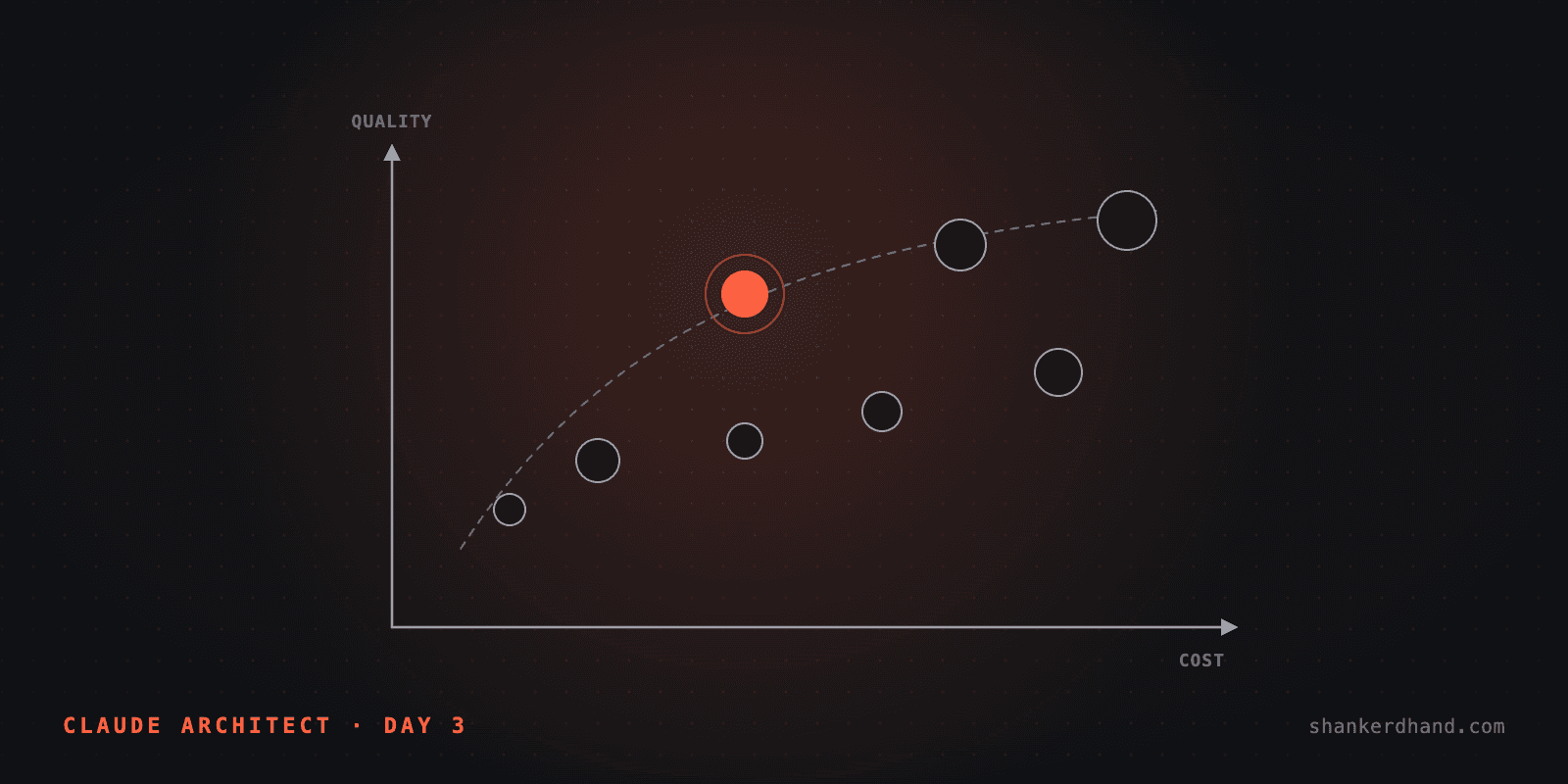
This is Day 3 of Claude Architect in 30 Days. Day 2 followed one API call from start to finish; its first field was model. Today is about filling it in: Claude comes in three tiers, and choosing between them is one of the few decisions that shows up directly on the bill.
Who this is for: anyone deciding which Claude model a feature should use, whether that's an engineer writing the integration or a founder looking at the costs.
The three tiers and what they cost
Each tier trades capability against speed and cost. These are Anthropic's list prices per million tokens for the current models:
| Model | Input | Output |
|---|---|---|
| Claude Opus 5.5 | $4 | $20 |
| Claude Sonnet 5.5 | $2 | $10 |
| Claude Haiku 5.5 | $0.10 | $0.50 |
Source: Anthropic's pricing page, November 2026. The Haiku price applies to prompts up to 100,000 tokens; longer prompts cost $0.50 in and $2.50 out.
Version numbers change every few months; the shape of the trade-off doesn't. That's the argument in choosing a model without a leaderboard: commit to the tier in your design, and pin the specific model in configuration.
Haiku: high volume, simple judgment
Haiku is for steps that run often and need a quick, narrow decision: sorting incoming messages into categories, tagging documents, pulling fields such as a name and an order number out of an email, deciding which part of the system should handle a request. These jobs run thousands of times a day, and the per-call price is what you feel.
Sonnet: the everyday workhorse
Sonnet is the sensible starting point for most work: chat, drafting, coding help, and agents that call tools. It's capable enough that most features never need more, at half of Opus's price.
Opus: when a wrong answer is expensive
Opus is for the steps where quality matters more than cost: hard reasoning, long plans with many steps, complex code, or anything where a mistake is costly to find and fix later. Paying more per call is cheap next to a wrong answer that reaches a customer.
Mixing tiers in one system
A system doesn't have to choose one. A common shape is Haiku reading each incoming request and deciding how hard it is, Sonnet handling most of them, and Opus taking the few that need it. Routing on the request's own difficulty is how that works in practice.
There's a second lever inside each model. Current Claude models take an effort setting that trades thoroughness for speed and tokens. Before dropping a tier to save money, try the stronger model at lower effort; it sometimes keeps the quality you need at a cost you can live with.
Test the cheaper tier first
Whatever you choose, decide with evidence. Run the cheaper tier against your own set of real examples, the eval harness idea from Day 1, and move up a tier only for the steps where quality actually drops. Guessing upward is how features end up on the most expensive model for jobs a cheaper one does just as well.
Try this today
Price one feature on all three tiers: tokens per request, times requests per day, times the price. Then compare the quality on your eval set before deciding. Tomorrow, Day 4 is about writing prompts that survive production. If you're designing a Claude system and want help choosing tiers for each step, that's part of what I do in LLM and RAG systems.
Prefer slides? Download today's carousel as a PDF.